
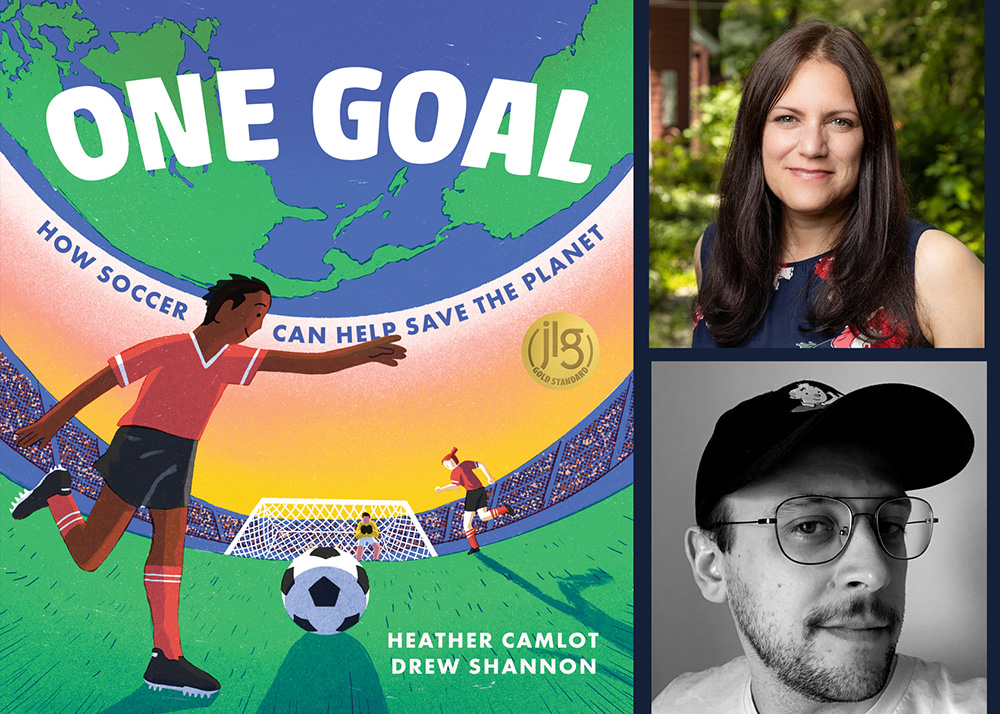
Photo credit for Heather Camlot: Marvin Shaouni, photo credit for Drew Shannon: selfie :-).
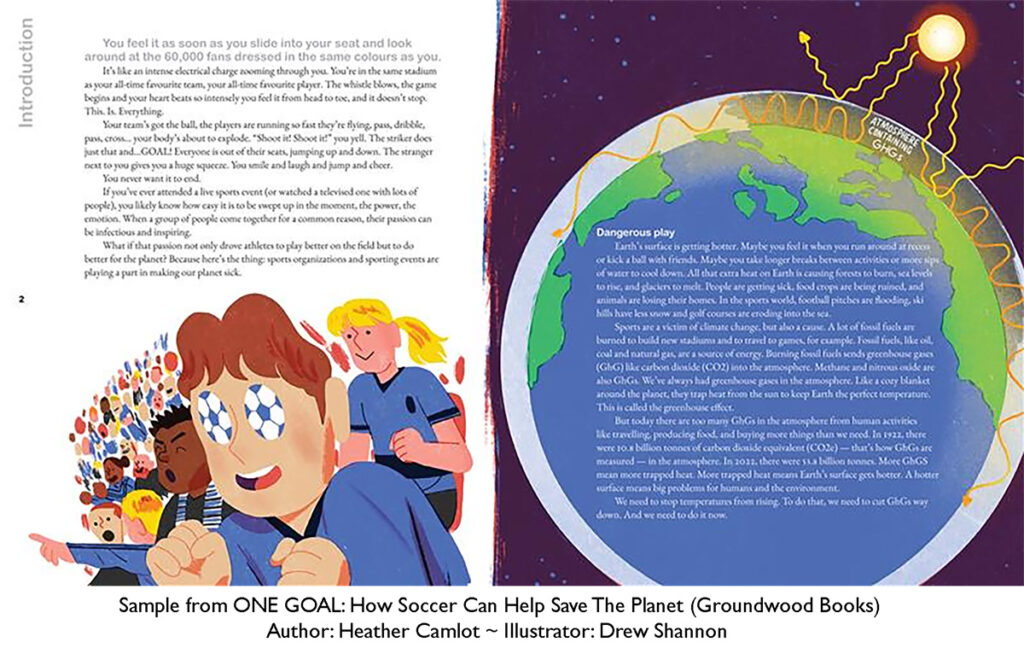
ONE GOAL: How Soccer Can Help Save The Planet shows how team spirit and passion for soccer can inspire action for a more sustainable future on – and off – the pitch. Written by Heather Camlot and illustrated by Drew Shannon, this nonfiction book for 9-12-year-olds launches from Groundwood on April 7, 2026. Excerpted quote from Kirkus: “A hopeful playbook that demonstrates how the beautiful game can help protect our beautiful planet.“
To those in Toronto: Join Heather and Drew at their book launch on Thursday, April 9th at 6:30 pm at Mabel’s Fables! See Heather’s Instagram post (check her feed for any updates/changes). “We’ll be talking art, words, soccer, turtles and climate change just before Earth Day and the FIFA World Cup, thanks to Groundwood Books!”
Heather Camlot is an award-winning children’s author, journalist, editor and translator. She has written several fiction and nonfiction books for young readers, including Clutch, The Other Side and The Prisoner and the Writer. Originally from Montreal, Heather lives in Toronto with her family. Website: heathercamlot.com. Instagram: @heathercamlot.
Drew Shannon was born and raised in London, Ontario. He co-created a young adult graphic novel with his friend and writing partner, Nathan Page, called The Montague Twins. Drew lives in Toronto with his cat, Ripley. Website: drewshannon.ca. Instagram: @bonyfingers.
Synopsis, from the publisher book page:
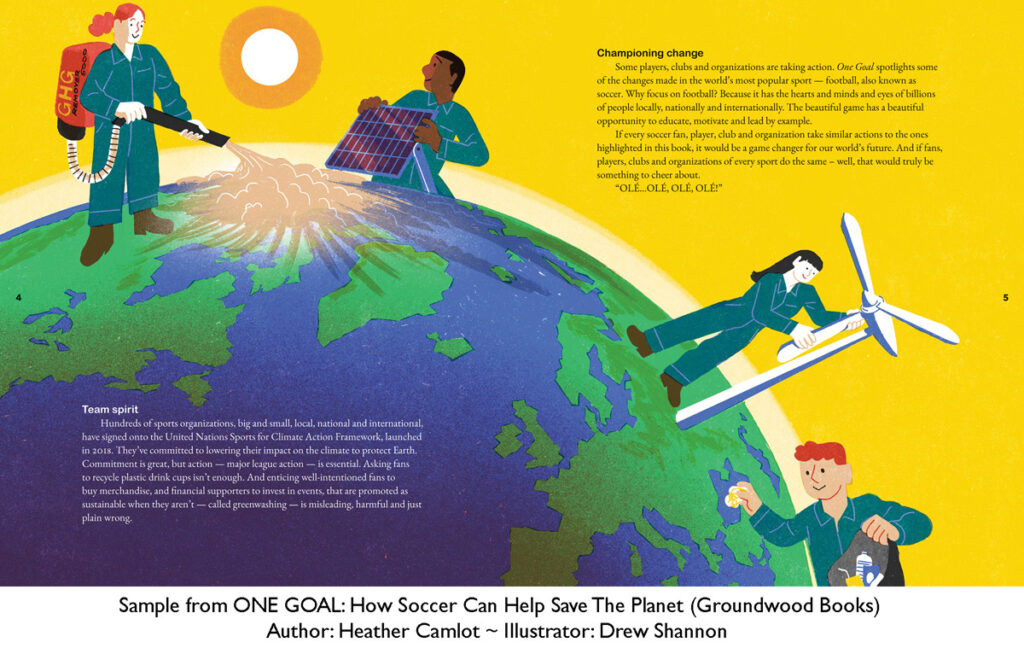
Publishing in advance of the 2026 World Cup, One Goal is a timely look at how soccer players, organizations, clubs and fans are taking action to do better for the planet.
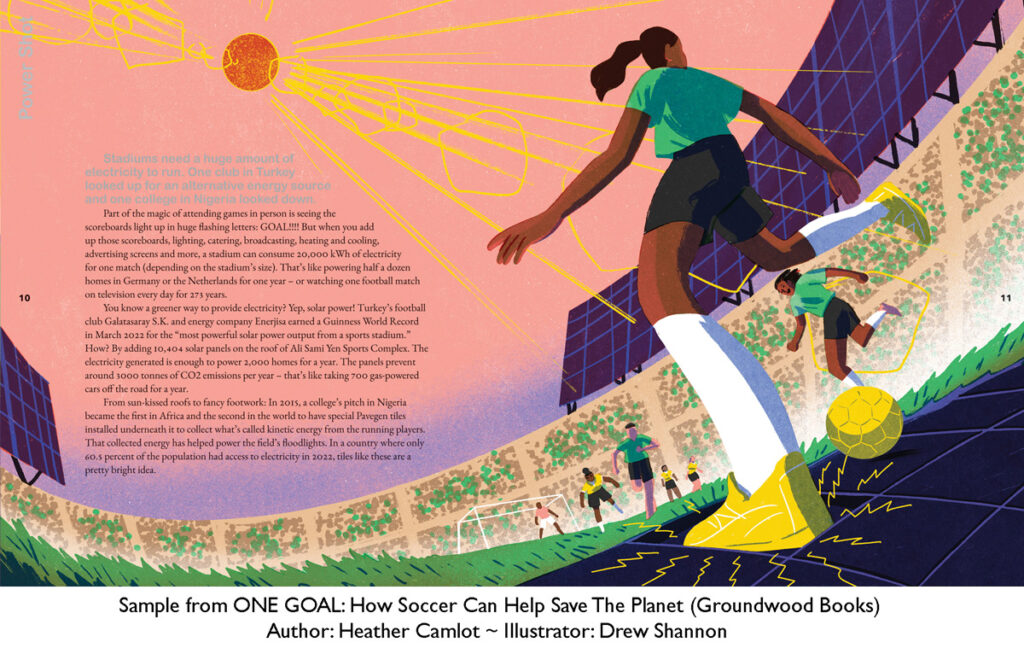
A college pitch in Nigeria uses the kinetic energy of players running over special tiles to power the field’s floodlights. South Africa uses local soccer fields to collect, store and clean rainwater for drinking. China built a high-speed bullet train to run between cities during the Asian Games, side-stepping high-emission air travel. Thousands of Belgian fans cycle to games instead of driving. New regulations about water breaks and game cancellations have been put into play to protect players from extreme heat.
Q. What do you hope young readers will help take away from your book?
Heather’s answer: I hope readers start noticing and questioning the things I’ve learned about while researching this book: How much water it takes to keep the field’s grass so green, how much energy is needed to host a game, how many cars are idling while trying to get out of a stadium parking lot… I hope they learn that we can all make changes – from the fans to the sports executives – to help cool down the planet while still playing and attending our favourite games.
Q. Drew, how do you create the illustrations for this book?
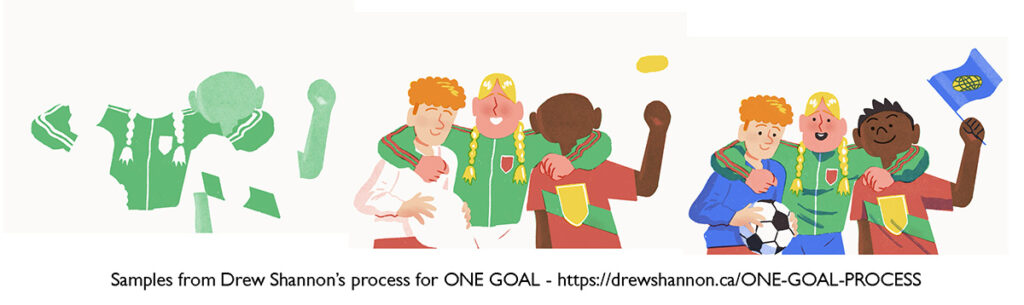
Drew’s answer: First, I make a loose sketch of what’s going on in the illustration where I try to think of the best way to show the important information but also make it feel fun and somewhat exaggerated. Then on my iPad, I build up layers of different-coloured artwork to create an image that feels like it was printed with a vintage-style process called screen printing. I use a limited selection of colours and when the colours are layered on top of each other they blend to make even more colours!
Q. Heather, what advice do you have for young writers?
Heather’s answer: Think about what interests you and write about it! I come across curious things online, on social media and TV, in newspapers and magazines all the time and I save them. I have a folder stuffed with strange and interesting stories. I love opening it up and looking through it — something always sets my mind in a creative direction.
Q. Drew, what advice do you have for young illustrators?
Drew’s answer: Keep drawing, but also keep learning; be a sponge and absorb everything. Different books, movies, music, experiences, and people will all help feed your creativity. Keep your mind open and ask questions about the world around you, then draw the answers you discover. Your biggest asset as an illustrator won’t be how well you draw, but your point of view.
Interested in seeing more interviews with book creators and other in the industry? See my Interview Archives. I’ve also compiled tips generously offered by interviewees in Advice For Young Writers & Illustrators For Industry Pros.